The Applied Research and Communication Fund co-authored the annual Transatlantic Subnational Innovation Competitiveness Index 3.0 report published by the Global Trade and Innovation Policy Alliance (GTIPA). The Report assesses 213 regions in Europe and the US across innovation indicators.
The assessment provides crucial insights for policymakers working to bolster national competitiveness and economic growth. The calculation of the Index uses 13 indicators across three categories: Knowledge Economy (33% weight), Globalization (12%), and Innovation Capacity (55%). This year the report includes an additional AI preparedness indicator due to AI’s growing relevance to economic development though it is excluded from the Index to ensure comparability with earlier assessments.
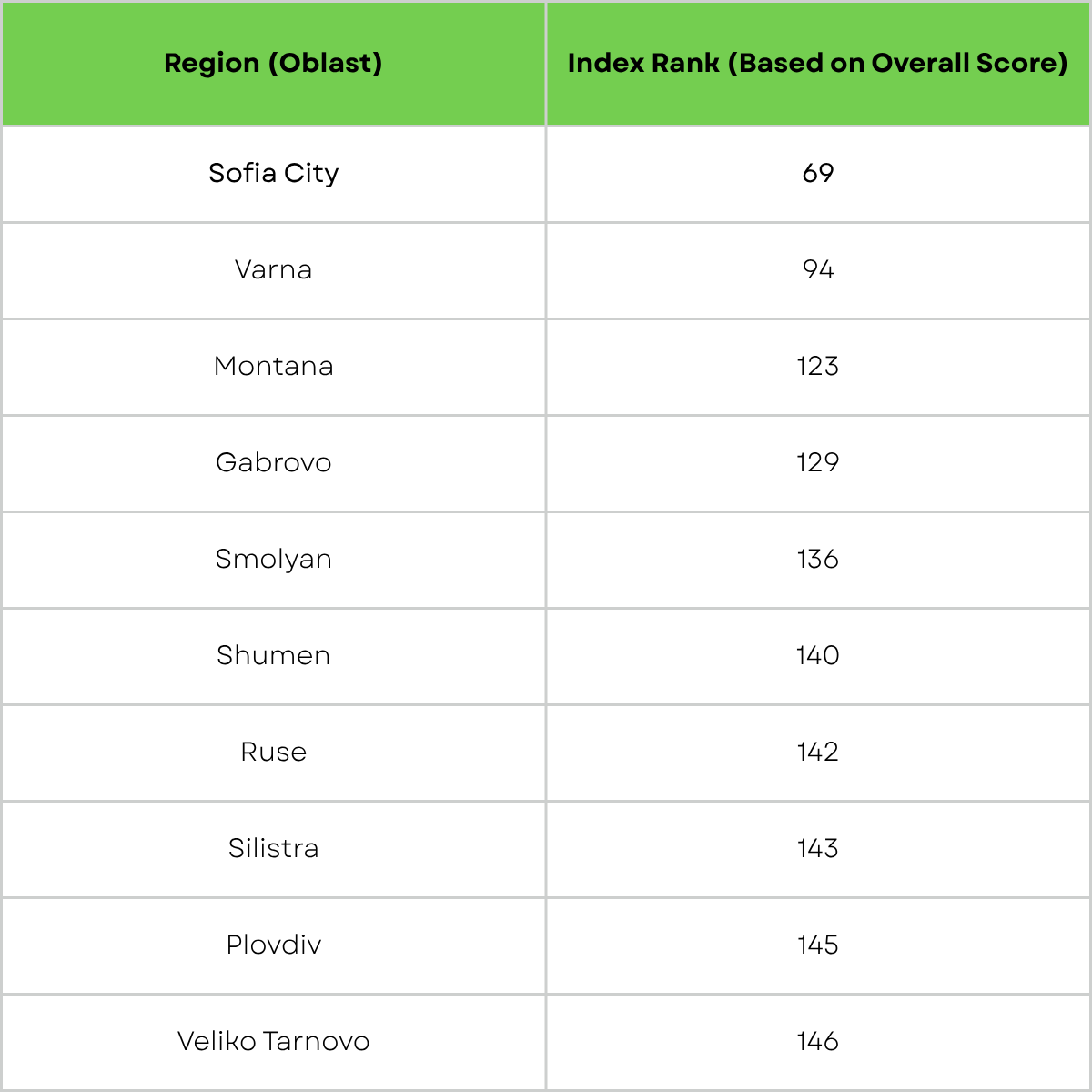
The index includes for the first time Bulgaria’s 28 provinces (oblasti). The country performs relatively well in areas such as a highly educated workforce and broadband internet adoption. Sofia City holds one of the highest FDI values. However, Bulgaria’s overall competitiveness performance remains stagnant, attributed mostly to low labor productivity. Additionally, Bulgaria has one of the widest internal divides in overall Index scores – Sofia City ranks 69th due to the high concentration of highly educated individuals, universities, and advanced industry, while most of the lowest overall ranked regions are from Bulgaria, such as Haskovo (208th).
Table 1. The top 10 highest ranked regions from Bulgaria for 2026
 The key findings for Bulgaria include:
The key findings for Bulgaria include:
- Low labor productivity, despite rising inputs – nine of the 10 lowest-productivity manufacturing regions are in Bulgaria (Silistra, Vidin, Blagoevgrad, Smolyan, Kyustendil, Dobrich, Haskovo, Montana, and Razgrad)
- High CO2 emissions – Sliven and Kyustendil are among the most-carbon intensive regions
- High variability in broadband adoption – Sofia City, Ruse, and Blagoevgrad perform strongly (adoption rates over 94%), but a 28-percentage-point gap separates the most- and least-connected regions, with Yambol’s connectivity sitting at 70.5%.
- Low patenting activity – Sofia City, despite being an outlier among Balkan regions, has only 28 patents per million residents, compared with nationwide averages of 100+ per million in higher-ranking countries.
- Substantial variability in the share of highly educated workers – Sofia City is one of the leading regions i for this indicator, but the median value for the country remains low.
- Highly concentrated inward FDI – Sofia Province holds one of the highest FDI values in the Index, while some other regions have no changes in their FDI stock.
- Lack of an AI adoption strategy – Bulgaria is currently missing a regional AI strategy, while the national concept for AI development lacks tangible implementation.
- Leverage FDI presence to upgrade local suppliers from assembly and subcontracting toward higher-value along the supply chains.
- Develop regional AI & skills plans by aligning AI/STEM initiatives with local industry needs while closing regional digitalization gaps.
- Adopt a long-term innovation strategy that sets goals for 2050, raises R&D spending to at least 1.5%+ of GDP by 2030, prioritizes innovation in budgets, and pursues judicial and antitrust reforms.
- Sign the Pax Silica Declaration to integrate Bulgaria into transatlantic co-investment and trusted-partner supply chains and strengthen institutional bonds to the U.S.
- Strengthen university research by offering competitive R&D compensation and Blue Card fast-tracks to attract highly skilled foreign professionals.
- Shift FDI policy toward higher-value investment by linking incentives to local benefits and operationalize the AI Concept 2030 for a national strategy.
- Take a stronger regional approach to EU funding to spread growth beyond Sofia and build stronger overall national capacity.