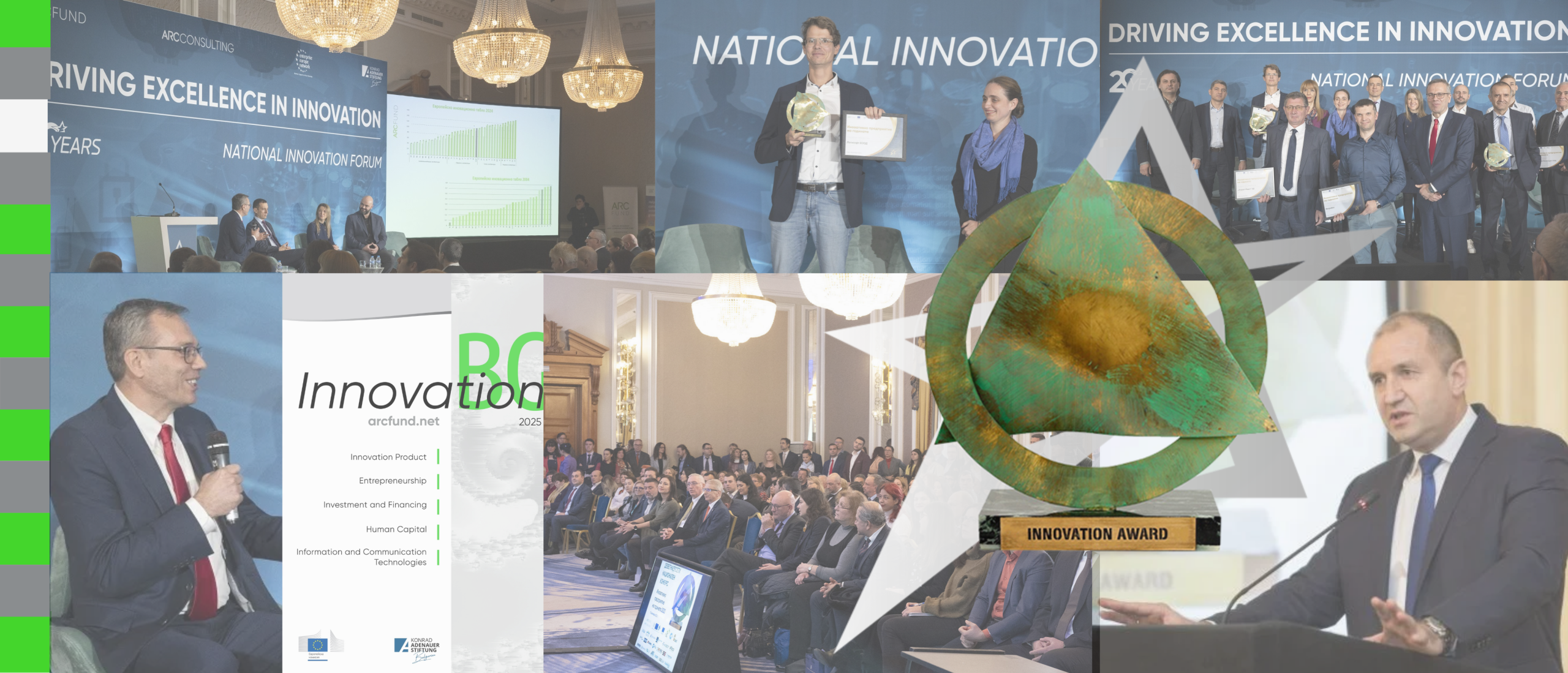
On December 9, 2025, Sofia hosted the 21st National Innovation Forum organized by the Applied Research and Communications Fund in partnership with the Konrad Adenauer Foundation and with the assistance of the European Commission Representation in Bulgaria. The event brought together leading representatives of business, academia, and public institutions.
For more than two decades, the National Innovation Forum has been uniting efforts to develop innovation in Bulgaria, presenting the key findings of the “Innovation.bg” report annually and recognizing the most successful Bulgarian companies through the “Innovative Enterprise of the Year” competition. This close link between analysis and recognition makes the forum a sustainable driver for innovation and greater competitiveness of the Bulgarian economy.
In his opening speech, Dr. Ognian Shentov, Chairman of the Board of Trustees of the Applied Research and Communications Fund, noted the profound global transformation we are witnessing and emphasized the need to rethink the future:
“In 2025, the world is entering a new era defined by three inseparable concepts: economic security, technological sovereignty, and geostrategic positioning. Today, supply chains are shortening, investments are seeking secure jurisdictions, and critical technologies are being developed within a circle of trusted partners. In this new reality, the ability to innovate is not only an engine for growth, but also a condition for national survival and national sovereignty.”
Mr. Norbert Beckmann-Dirkes, Head of the Konrad Adenauer Foundation’s Representative Office in Bulgaria, welcomed the participants in the Forum, emphasizing the key role of innovation for the growth and competitiveness of both Bulgaria and the European Union. He stressed that Bulgarian companies can be creative and successful at the international level; that Bulgaria is capable of strengthening regional integration, supporting sustainable supply chains, and playing a leading role in building a connected, innovative, and competitive Europe.
Ruslan Stefanov, Director of Strategy and Innovation at the Applied Research and Communications Fund, presented the main conclusions of the Innovation.BG 2025 report. According to the study, Bulgaria remains among the so-called “emerging innovators,” ranking 26th in the EU in the European Innovation Scoreboard. The report highlights two key issues for Bulgarian innovation policy and ecosystem related to the country’s innovation and entrepreneurial capacity, respectively. Despite the huge increase in R&D expenditure, which has risen almost eightfold over the last 20 years, its share of GDP and absolute amount remain extremely low in a European context. The country’s efforts to date to build innovation capacity have not yielded the results that its low starting position suggests are possible. At the same time, strong youth entrepreneurial attitudes do not lead to mass lifelong learning or even to entrepreneurial activity comparable to the European average, due to a stronger fear of failure. Bulgarian entrepreneurs are ready to give up much earlier than others.
Innovation.bg 2025 recommends focusing on five priorities: strengthening investment in critical technological and scientific infrastructure, integration into EU supply chains, development of a capital market integrated with the major ones in the EU, energy modernization, and STEM reforms, including the promotion of science in universities.
The conclusions and recommendations from the Innovation.bg 2025 report were discussed and supplemented by a special panel of five guests.
Vasil Terziev, Mayor of Sofia, shared his vision for the innovative future of the city: “Our goal is to make data about the city accessible and to use it to generate innovation. Our goal here is to develop know-how that we can export.”
Doncho Barbalov, Deputy Minister of Economy and Industry, emphasized that “in order for [innovation] policies to be effective, they must be sustainable and there must be sufficient continuity in their implementation.”
Lilyana Pavlova, Senior Advisor at the Applied Research and Communications Fund and Vice President of the European Investment Bank (2019-2023), compared the barriers and positive developments in the field of innovation and presented the following three recommendations:
- Use all available funds and resources for capacity building and project preparation;
- Establish a venture capital fund in Bulgaria;
- Reform educational institutions.
Nadezhda Gancheva, senior analyst in the Energy and Climate Program at the Center for the Study of Democracy, emphasized the need for long-term visions and policies to achieve innovation in a sector such as energy, where some projects, such as nuclear energy, require a lifetime to implement. Therefore, national goals must remain consistent and shared.
Krum Pavlov, founder and manager of LogiSoft and winner of the Innovative Enterprise of the Year 2024 competition, shared the following advice: “Conditions are now dramatically better than they were at the beginning of democracy. If you start a business now, there is a chance you will not succeed, but if you don’t start at all, you are bound to fail. Many successful businesses are based on past failures.”
The culmination, as is tradition, was the awards ceremony for the National Innovative Enterprise of the Year competition. The award-winning Bulgarian companies prove that innovation is a key driver of sustainable economic progress both in Bulgaria and in Europe.
- Wiser Technology received the award for “Market Leadership: Artificial Intelligence, Technological Sovereignty, and Economic Security.”
- MClimate AD was recognized in the category “Green Technologies, Energy Sustainability, and Climate.”
- AMG Technology EOOD and Waves Vision EOOD were recognized in the category “AI Transformation, Automation, and Digital Economy.”
- Organic Invest Bio Protection OOD was recognized as the winner in the category “Innovations for Quality of Life, Health, and Biotechnology.”
- Fadron OOD received the award for “Start-up with High Innovation Potential.”
Read the full speeches by Dr. Ognyan Shentov and Mr. Norbert Beckmann-Dirkes here.