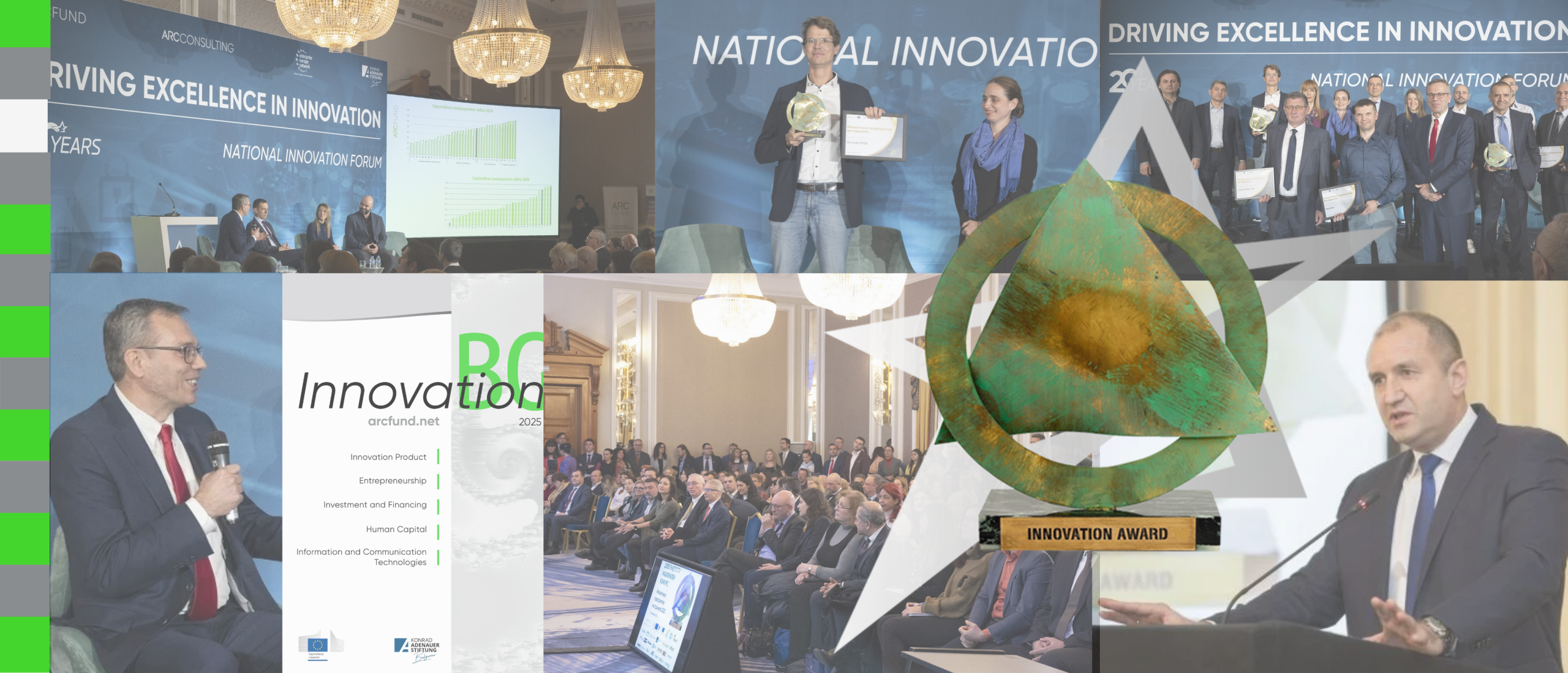
On October 9, 2025, the Applied Research and Communications Fund organized the second event in the national “Dialogue Innovation.bg 2040” tour. It took place in Ruse, in partnership with the European Commission Representation in Bulgaria, Sofia Tech Park, and INNOBRIDGE BIC.
The round table brought together representatives from business, academia, the financial sector, and public institutions, with the topic of discussion being the development of successful national policies for innovation and technology transfer in Europe.
Among the key points were the following:
- Bulgaria has significant innovation potential, which could be realized more fully if there were functioning regional technology transfer offices that were well integrated into a national network.
- Ruse has considerable experience in technology transfer, but remains isolated from the national innovation system in terms of infrastructure and cannot take sufficient advantage of its proximity to Bucharest as an important industrial and innovation center in the Balkans.
- Young people are key to the future development of innovation, so they need to be encouraged by high-quality mentoring programs that help them turn their innovative ideas into business reality.
- Universities need to integrate more practical training into their educational programs and maintain better cooperation with their students’ future employers.
- Bulgaria needs intelligent planning in the development of innovation to facilitate innovators at every step of the way from the laboratory to the market.
- The innovation development system remains too centralized. There is a need for improved cooperation at the regional level, as well as better communication within local technology and business communities.
Natanail Stefanov, Deputy Chairman of the Management Board of Sofia Tech Park, noted that the path to significant innovation passes through research institutions, where ideas with the potential for national impact are born.
In order to develop applied scientific research and accelerate real innovation, a single center is needed to coordinate the use of scientific infrastructure and allow scientists to work together without having to move between universities. This will enable them to make effective use of their knowledge and contacts and commercialize their scientific activities.
Prof. Daniel Bratanov emphasized that in Bulgaria, the connection between science and business remains extremely weak and there is mutual misunderstanding, which meetings such as Innovations.bg 2040 can help remedy. Small businesses often perceive innovation to be something that is new to the company itself, rather than to the market— while that is company development, it is not true innovation by scientific standards. On the other hand, universities need to better understand these limitations of small and medium-sized businesses in order to achieve effective, practical cooperation.
According to Prof. Bratanov, for technology transfer offices to work effectively, funds need to be able to value innovation by assessing intellectual property. It is this assessment that can become a financial tool to support the development of science-based innovation and its implementation on the market.
Svetlana Stefanova, Executive Director of FAAC Bulgaria, emphasized that cooperation between business and universities in Bulgaria is still mainly focused on student training, providing internships, and career guidance.
However, there is a lack of sustainable practices and real partnerships between companies and academia when it comes to technology transfer. According to Stefanova, the role of business is to create an environment that encourages and supports employees, students, and young entrepreneurs to turn their ideas into innovations.
Milen Dobrev, chairman of the Innobridge Business Innovation Center, noted that in order to effectively finance technology transfer and innovation, businesses need to have an integrated support chain throughout the entire innovation process.
Dobrev emphasized that a network of business angels to provide resources for innovation is almost non-existent in the regions. A systematic approach is needed to enable the regional innovation ecosystem to develop comprehensively and sustainably.
Lidia Rasheva, senior expert at the European Projects and Financial Institutions Directorate of the Bulgarian National Bank, emphasized that banks, thanks to their extensive network, are an effective tool for providing guarantee and financial instruments to support business. These mechanisms, provided by institutions such as the Fund of Funds and the European Investment Fund, play a key role in facilitating access to finance and stimulating innovation in the economy.
Stoyanka Koleva, project manager at NRG Soft Ltd. and participant in the annual award of the Applied Research and Communications Fund for Innovative Enterprise of the Year 2024 shared that in the company’s practice there are many opportunities for funding and cooperation with universities in the implementation of innovative projects and gave a number of specific examples of successful projects implemented with the support of the European Commission.
She emphasized that their focus is increasingly shifting towards European programs such as Horizon Europe, which provide sustainable opportunities for the development of scientific and applied research and the implementation of innovative technological solutions.
Plamen Ivanov, Project Manager, Applied Research and Communications Fund, concluded by emphasizing the importance of celebrating the achievements of innovative companies in Bulgaria in order to create positive role models for technology development and transfer, and urged all attendees to spread the word and participate in the Innovative Enterprise of the Year 2025 competition, which will be presented at a ceremony in Sofia on December 9, 2025.