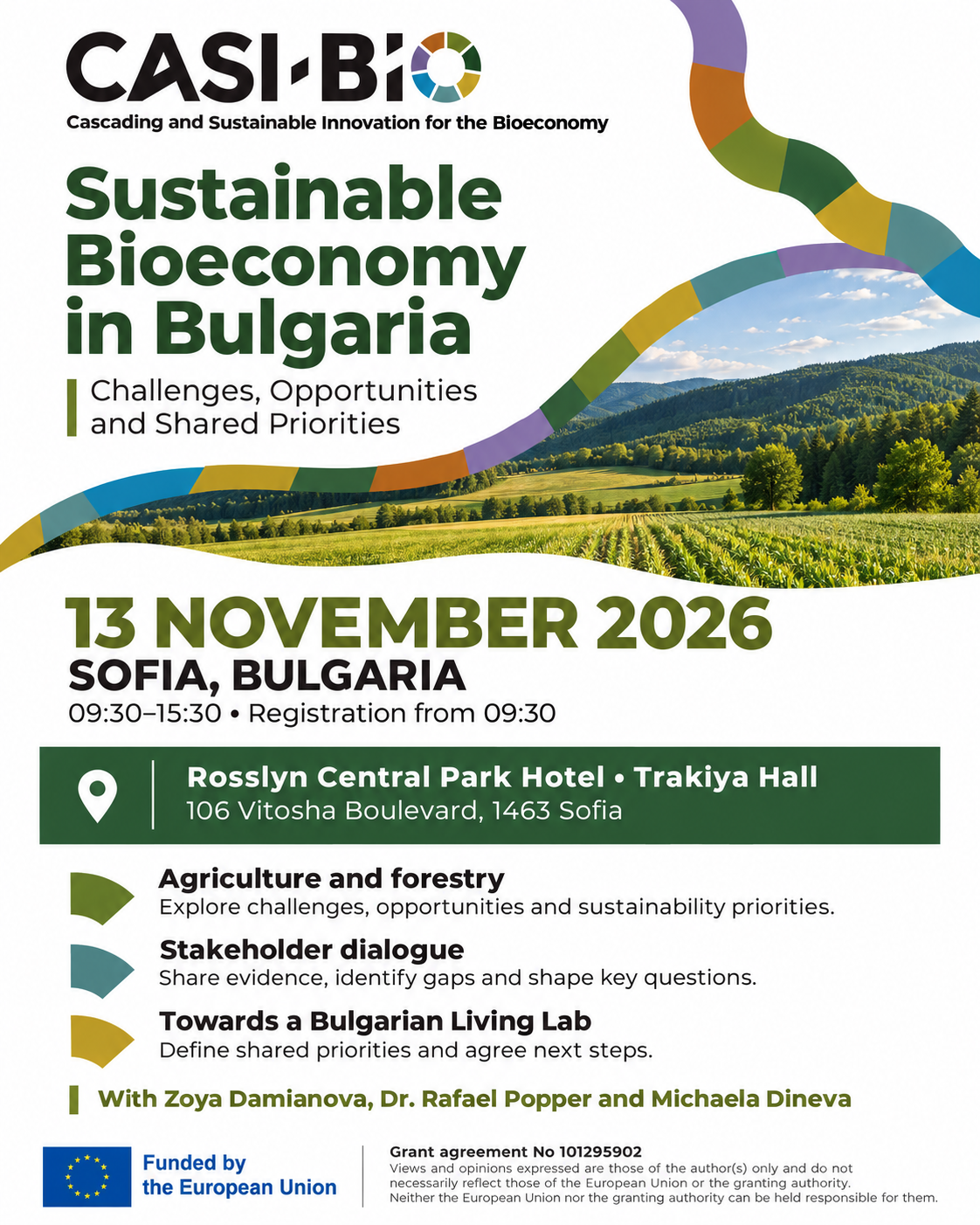
How can biological resources be used more efficiently without compromising food security, natural ecosystems or social fairness? Addressing this challenge requires not only new technologies, but also better governance, evidence-based policies and the active involvement of businesses and local communities.
CASI-BIO aims to turn the principles of a sustainable bioeconomy into practical solutions that can be applied across different economic and social contexts. Jointly coordinated by the Applied Research and Communications Fund (ARC Fund) and Technology Partners Foundation (TPF), Poland, the initiative brings together 15 partners from 14 countries, including Uruguay, Kenya and New Zealand. CASI-BIO is being implemented with the support of the EU’s ‘Horizon Europe’ programme.
Making the bioeconomy work for people and the environment
A sustainable bioeconomy depends not only on technological progress, but also on how biological resources are used, how decisions are made and who benefits from the transition. CASI-BIO will help translate principles such as cascading biomass use and the food-first hierarchy into practical rules and decision-making processes.
Through 13 living labs, agricultural enterprises, small and medium-sized enterprises, public authorities and local communities will work together to develop and test solutions in real-world settings. The initiative aims to develop, study and analyse more than 180 innovations and technological solutions, while ensuring that rural communities and marginalised groups have a voice in shaping new approaches to a sustainable bioeconomy.
Social justice and gender equality are integral to this process. By identifying gaps in equity, institutional capacity and innovation performance, CASI-BIO will help establish the conditions for a transition that is environmentally sustainable and socially fair.
From evidence to policy and implementation
For sustainability principles to deliver lasting impact, they must be integrated in public policies, governance practices and decisions on the ground. CASI-BIO will develop policy roadmaps, recommendations and practical tools to support this process, linking its work to key European priorities, including the Common Agricultural Policy, the Agricultural Knowledge and Innovation System (AKIS), the EU’s Zero Pollution initiative and the Mission ‘A Soil Deal for Europe’.
Digital knowledge infrastructure will also play a central role. By expanding the existing CASIPEDIA database of good practices, CASI-BIO will develop a dynamic knowledge hub bringing together practical solutions, sustainability indicators and learning resources. Open dashboards and interoperable digital tools will improve transparency and make evidence and solutions easier to compare and apply.
Building lasting capacity for a fair bioeconomy
Running until 2029, CASI-BIO aims to leave a lasting legacy beyond its research findings: practical governance solutions, actionable policy roadmaps and knowledge resources that can continue to support policymakers, businesses and communities.
By connecting scientific evidence, real-world experimentation and policy development, CASI-BIO will contribute to a bioeconomy that uses resources responsibly, protects biodiversity and addresses climate change, while placing fairness and public participation at the heart of the transition.

Views and opinions expressed are however those of the author(s) only and do not necessarily reflect those of the European Union or the European Commission. Neither the European Union nor the European Commission can be held responsible for them.